Auto Flight
The system provides guidance and control as well as automatic thrust from takeoff until touchdown. It includes:
- AFDS
- Dual autopilots
- Auto-throttle
The controls for the autoflight system are located on:
- MCP
- Control wheels
- Thrust levers
- CDUs
Flight Control Computer
There are two flight control computers that control the two autopilots:
- FCC A → autopilot A
- FCC B → autopilot B
The FCCs process inputs from the:
- MCP
- FMCs
- Auto throttle
- Control column/wheel position
- Autopilot actuator
These inputs are used to generate flight director commands and drive the respective flight control actuators. The FCCs also provide commands to:
In general, only one FCC will be controlling the FDs and the autopilots. However, both FCCs control the aircraft when:
Link to original
- In TO/GA below 400 AGL
- When
APPis engaged and LOC/GS are both captured
Autoflight System Interface
The flight crew controls the autoflight system with switches located on the:
The autoflight system status is displayed on:
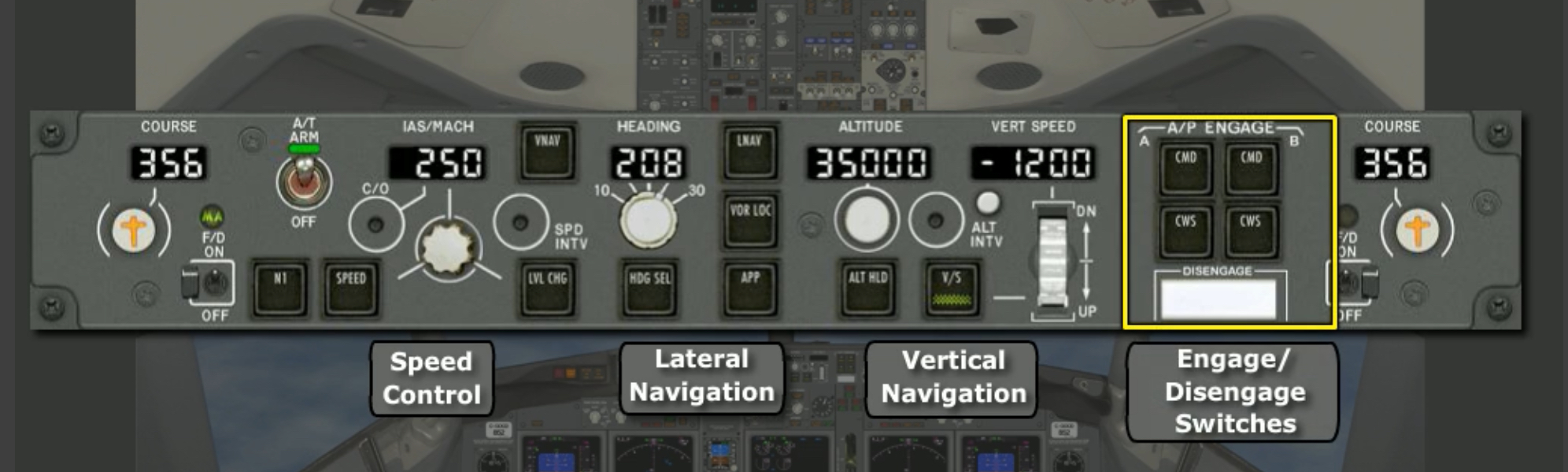
Mode Control Panel
Primary panel control for autoflight system.
It can be broken down into four sections:
- Speed control
- Lateral navigation
- Vertical navigation
- Engagement/disengagement switches.
Speed controls are primarily used to command the auto throttles when the system is armed. Should an
8flash in the speed selection display, the commanded speed is greater than an over-speed limit; if the speed commanded is less than minimum speed, a flashingAwill appear.Under certain conditions, autopilot modes cannot be deselected. On the MCP, an illuminated mode light indicates that the mode can be deselected; once the light is out (with the mode active as shown on the FMA), the mode can only be disengaged under certain conditions. For example,
APPmode can only be disengaged by:
- Pushing a GA switch
- Disengaging the autopilot and turning off both flight directors
- Selecting a different VHF NAV frequency
This type of logic also applies when trying to select modes that conflict with current autoflight mode.
What does a flashing
Link to original8andAmean on the MCP Speed display?::8means commanded speed is > an over-speed limit;Ameans < minimum speed.
Auto-throttle
The autothrottle system can be used during:
- Takeoff
- Climb
- Cruise
- Descent
- Approach
- Landing
- Go-around
The autothrottle modes can be selected by:
- Manually selecting modes on the MCP
- Automatically allowing the autoflight system to select the proper mode
- Pressing GA switches.
The autothrottle system can operate in two modes: N1 and SPEED. The former maintains a specified thrust value and does not increase or decrease to compensate for airspeed. This mode is generally used for takeoff and climb.
SPEED mode can further be divided into FMC SPEED or MCP SPEED, depending on where the speed command is generated.
Summary of A/T mode engagements:
-
A/T SPD of N1 engaged when AFDS pitch mode engaged
-
A/T N1 engaged when engaging
LVL CHGorVNAVclimb -
RETARD -> ARMmodes whenLVL CHGorVNAVdescent -
If not
VNAV,ALT ACQorALT HLDengage A/T inMCP SPD; else it remains onFMC SPD -
Enagement of G/S capture engages A/T in
MCP SPD -
Alpha floor engages A/T when armed
-
Go Around modes
There are two go-around modes for the autothrottle system. On a first press of the TO/GA switch, a “reduced thrust” go-around N1 is commanded, designed to target a 1,000 - 2,000 fpm climb rate.
Should the TO/GA switch be pressed again, the autothrottle will set a “maximum thrust” go-around N1.
Thrust Levers
The forward thrust lever position is sent as an angular value to the EEC, which in turn uses the signals to control the engines. The levers themselves can by controlled manually or by the auto-throttle system by two individual servo motors.
Link to original
Additionally, the autothrottle will switch to THR HLD mode on takeoff through 84 knots. This inhibits the autothrottle servos so that pilots can adjust thrust as necessary without concern of disagreement between lever position and autothrottle commands.
Above the N1 displays the thrust mode is shown. It consts of the active N1 limit and is used as a guide for where thrust should be set, normally calculated by the FMC. The indications correspond to the reference N1 bugs. This thrust limit can be viewed on the CDU
Link to originalN1 LIMITpage.
Link to original
Indication Mode TO Takeoff D-TO Reduced (derated) takeoff CLB 1/CLB 2 Reduced climb CRZ Cruise G/A Go-around CON Continous ---.- FMC not computing limit A/T LIM FMC is not giving A/T N1 limits
Flight Mode Annunciator
Displays the autopilot and flight direct engaged/captured and armed modes in three columns:
Autothrottle Modes Roll Modes Pitch Modes N1LNAVTO/GAGAHDG SELALT HOLDRETARDVOR/LOCMCP SPDFMC SPDFLAREMCP SPDVNAVTHR HLDV/SG/SBelow the FMA, just above the ADI, is the AFDS annunciation that displays whether the Flight Director, Autopilot, or Control Wheel Steering is engaged:
FDis displayed when the autopilot is either disengaged or in CWS while the FD is on.CMDis displayed when one or both autopilots are engagedSINGLE CHis displayed during single autopilot ILS approaches*Note: for dual autopilot ILS approaches,
SINGLE CHannunciates after LOC capture and extinguishes after pitch monitor confidence test is complete.Below the centre FMA and just above the AFDS display is the Control Wheel Steering indications. There are two amber indicators that correspond to:
Link to original
CHS R- rollCHS P- pitch
Autopilots
There are two autopilots, one attached to each FCC.
The main mode of operation is CMD mode, which enables all command modes and allows the autopilot to be controlled through the MCP and FMC. To engage the autopilots the CMD or CWS switches must be pressed, assuming the following conditions are met:
- No force applied to control wheel
- Stabiliser trim
AUTOPILOTcutout switch is in theNORMALposition
Only one autopilot can be engaged at the same time, except while on APP mode. During single A/P operation:
- Full automatic flare and touchdown capability are disabled
- A/P go-around capability is disabled
- And the A/P should not remain engaged below 50 ft AGL
Alternatively, the autopilots can be placed in CWS mode. This allows the crew to fly as though the autopilot was disengaged; forces on the control wheels are sensed by the FCCs, which then send the appropriate signal to the pitch and roll servos. It can be engaged automatically when either a pitch or roll mode has not been selected/deselected
Speed Limiting
The autoflight system provides protection for the following maximum and minimum speed limits:
- Minimum speed
- Vmo/Mmo
- Flap Placard Speed
- Gear placard speed
On the MCP the max speed that can be selected is Vmo/Mmo. As flaps are extended, the maximum speed bar adjusts to the maximum flap placarded speed, although Vmo continues to be the max speed on the MCP. However, the aircraft will only accelerate to the red tape on the PFD, and not to the MCP speed.
Which FCC provides necessary input data for Autopilot A?::FCC A.
Commands to the autoflight system that are typically “short term” in nature and entered in the ___ .::MCP.
During descent a flashing 8 appears on the IAS/MACH Display window. What does this indicate?::The commanded speed cannot be reached because it is greater than the over-speed limit.
An illuminate MCP switch indicates the active navigation mode.::False, it indicates that it can be de-selected.
How is the FO’s FD selected as the Master?::By selecting the FO’s F/D switch ON first, or by engaging Autopilot B to CMD.
How does CWS allow the pilot to control the aircraft?::Moving the control wheel sends signals to the autopilot commanding pitch and roll.
What is required to engage an autopilot in CMD?::No force applied on the control wheel and Stab Trim AUTOPILOT Cutout switches NORMAL.
During climb the autothrottle mode is N1. What does the autothrottle command?::A fixed thrust setting at climb N1.
How is the autothrottle disengaged?::Two seconds after touchdown, selecting A/T ARM off on the MCP, pressing A/T Disengage on the thrust levers.
To make a heading change greater than 180 degrees, HDG SEL should be pressed then the Heading Selector rotated in the direction of desired turn.::True.
What is required to engage LNAV when the aircraft is >3 miles from the FMC route?::Aircraft must intercept route before active waypoint, on an intercept heading of <90 degrees.
How does the 737NG descend in LVL CHG?::The aircraft controls pitch to maintain speed, thrust levers retard to idle.
During a descent in VNAV PTH, pitch maintains vertical flight path while aircraft speed is secondary.::True.
The SPD INTV switch allows crew to change the FMC target speed while remaining in VNAV.::True.
What speed does the F/D command during climb shortly after takeoff?::V2+20 kts.
Once the G/S captures, how can the approach mode be exited?::Disengaging autopilot and both F/Ds, pushing TO/GA, retunning VHF NAV radio.
Will the autopilots remain engaged when windshear is encountered during a single autopilot approach?::Yes.