Fire Protection Systems
The fire protection systems monitor the airplane for the following conditions:
- Fire
- Smoke
- Overheat
The fire detection and extinguishing systems provide monitoring for:
Overheat detection systems are installed for:
To test the system for faults, set the TEST switch to FAULT INOP and confirm that five lights illuminate:
- Master Caution lights (2)
OVHT/DETannunciatorFAULTlightAPU DET INOPlight.
To test the fire system set the TEST switch to OVHT/FIRE and confirm that the following lights illuminate:
- Master Fire Warning
- Master Caution lights
- Both engine fire switches
- APU fire switch
- Wheel Well fire warning light (if AC power available)
- ENG 1/2 Overheat lights
- OVHT/DET light
Extinguisher tests are accomplished with the ENXIGES EXT TEST switch.
Engine Fire Protection
Detection systems
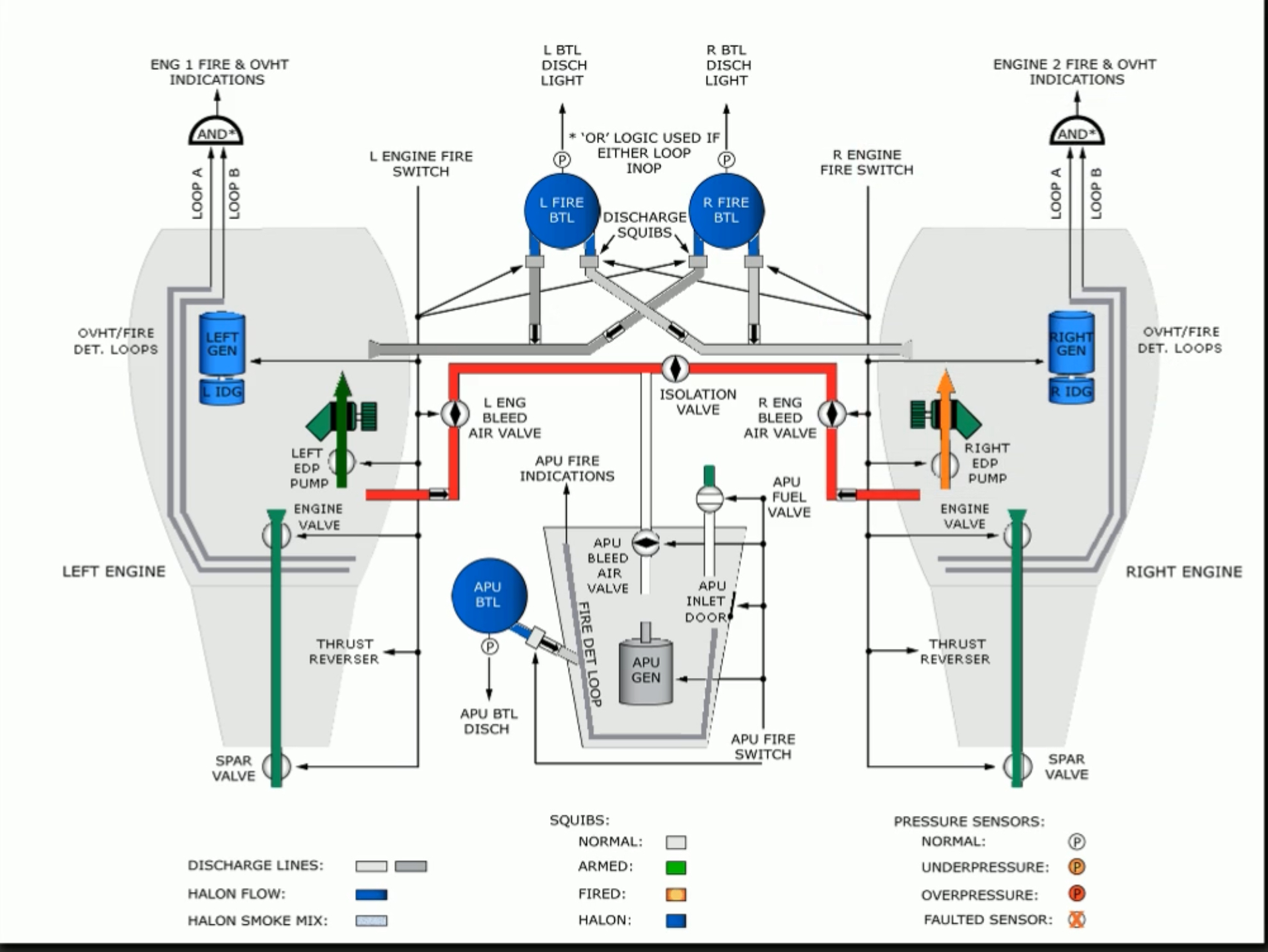
The engine overheat and fire detection system uses detector loops in the engines. The loops monitor the engines for overheat and fire conditions. Each engine contains two fire detection loops.
The ENG OVERHEAT or engine fire switch remain illuminated until the detector loop temperature drops below the onset temperature, although a crew should assume the engine remains on fire until the light goes out.
The active detection loop can be specified with the OVHT DET switch. In NORMAL, both loops must detect overheat/fire to cause an overheat or fire alert. Should one of the loops fail while in NORMAL position, the failed loop is deselected and the remain loop functions as a single loop detector.
Overheat and fire detection are powered by the battery bus, while fire extinguishing systems are powered from the hot battery bus.
Should an engine fire occur, the Master Warning Fire, Master Caution, OVHT/DET, ENG # OVERHEAT, and associated fire handle will illuminate, along with a fire bell. Additionally, the associated fire handle will automatically unlock (if it does not unlock, there is a manual unlock switch underneath).
Fire Switches
When illuminated, the Fire Switches indicate that there is a fire in the associated engine. Pulling the switch causes the following to occur:
- Both engine and spar fuel shutoff valves closes
- Associated engine bleed air valve closes (and thus the associated pack valve, thus inhibiting wing anti-ice)
- The generator control relay trips
- Hydraulic fuel shot off valve closes (and the hydraulic LOW PRESSURE light is deactivated)
- Thrust reverses is disabled
- Fire Warning switch can be rotated for discharge
- One discharge squib on each engine extinguisher is armed.
Extinguisher system
The system consists of two extinguisher bottles located on the top left corner of the main wheel well. They use halon as an agent. Either or both can be discharged into either engine.
Rotating the fire switch electrically fires a squib that discharges the extinguisher into the engine. Note that the switch needs to be pulled up and rotated for a minimum of one second.
To fire the left/right extinguishers, rotate the fire switch handle left and right as appropriate.
APU Fire Protection
The APU fire detect system uses a single fire detection loop. Like the engines, the APU fire switch remains illuminated until the loop cools below the onset temperature.
In addition to the Fire Switch and other monitoring in the flight deck, the APU Fire Control Handle is located on the Ground Control Panel in the aft section of the right wheel well This only operates on the ground.
The APU Ground Control Panel contains:
- Fire Warning Light
- Fire Control Handle
- Fire Warning HORN CUTOUT switch
- APU BOTTLE DISCHARGE switch
Pulling the APU Fire Control Handle causes the following:
- Arms APU Bottle discharge switch
- Closes APU shutoff
- APU Bleed air is shutoff
- APU inlet door is closed
- Trips generator control relay and breaker
On the flight deck, the indications of an APU fire:
- Fire Warn Master Warning
- APU Fire Switch illuminates and unlocks
- APU shuts down
- Fire warning bell sounds
- Wheel well warning and light occur
Pulling the APU Fire Handle switch up:
- Provides automatic backup for shutdown
- Arms APU extinguisher unit
- Deactivates fuel solenoid and closes APU shutoff valve
- Closes the APU bleed air valve
- Closes APU inlet door
- Trips generatort control relay and breaker
- And unlocks Fire Switch
The APU fire extinguisher bottle is located in the vertical stab. Rotating the Fire Warning Switch in either direction discharges halon into the APU compartment.
Cargo Fire Protection
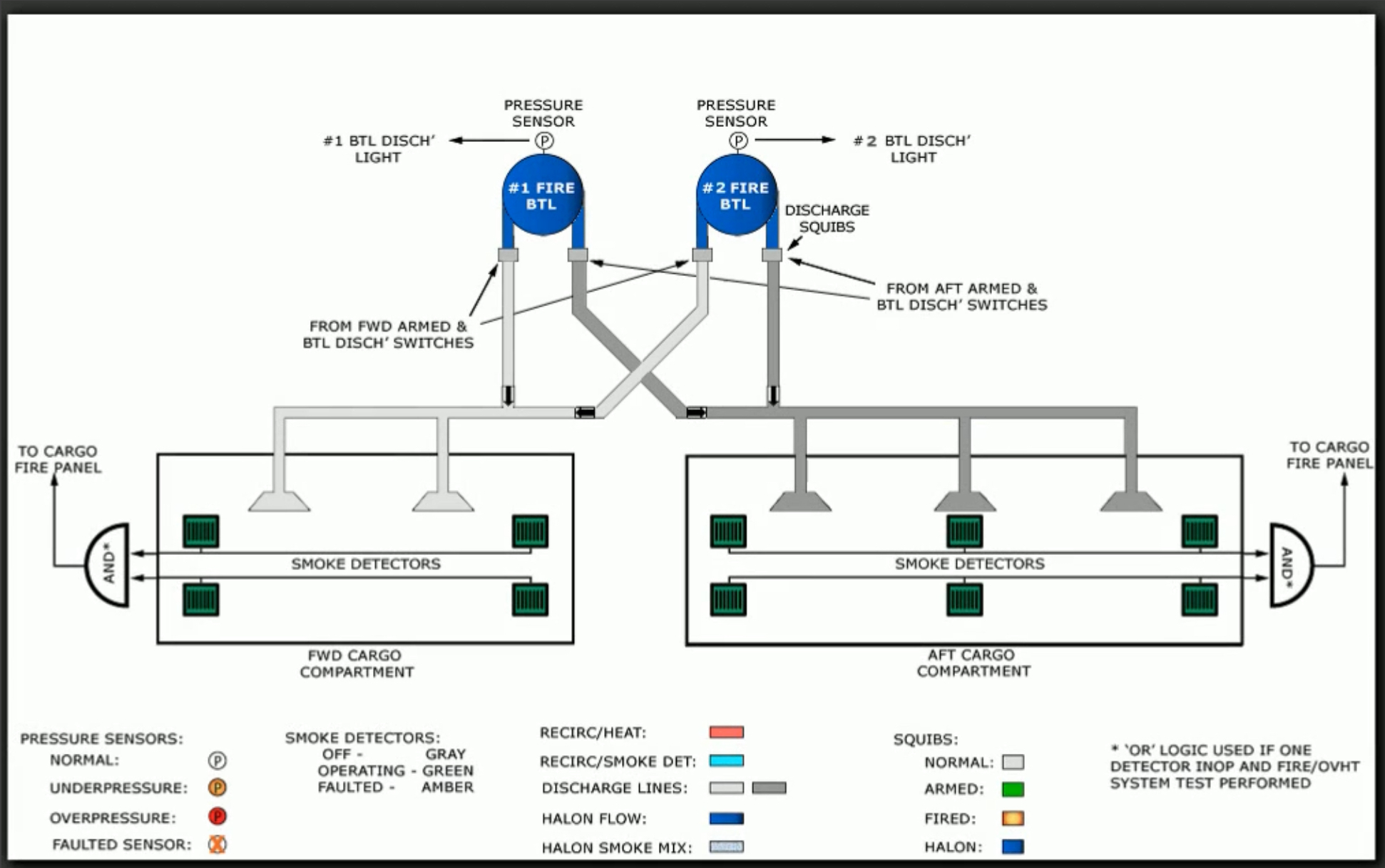
The forward and aft cargo compartments have ceiling mounted smoke detectors in a dual loop configuration. The forward cargo compartment has 4 detectors while the aft cargo compartment has 6.
They are powered by DC Bus 1 and 2.
Each detector monitors cargo for smoke or heat. Indications will be displayed on the Cargo Fire Panel, which controls the cargo fire system. There are DET SELECT switches there that can select either a single loop, A or B, or be set to NORM for both.
Testing
When testing the system, the DETECTOR FAULT amber light will illuminate only if both loops in one or both cargo compartments have failed. During a cargo fire test, however, the light will illuminate if any one detector fails.
The light also illuminates if DC Bus 1 and 2 are not powered, as that is the power source for the system.
A successful cargo fire test can be accomplished by pressing the cargo fire TEST switch and illumination of the following 5 lights:
- Both Master Fire Warn
- Extinguisher test lights
- FWD/AFT fire warning lights
- Cargo fire bottle
DISCHlight
Fire detection and control
Additionally, the DETECTOR FAULT light remains extinguished and a fire warning bell sounds. If the DETECTOR FAULT light illuminates during a test, the affected fire warning light will not illuminate.
The indications of a cargo compartment fire in either compartment are:
- Both Master Fire Warn lights illuminate
- FWD/AFT cargo fire warning light(s) illuminate
- Fire warning bell sounds
There are two fire extinguisher bottles in the AC distribution compartment on the forward wing spar. To arm the extinguisher, push the appropriate cargo fire ARM switch (same switch that is illuminated to indicate a fire).
Once armed, the bottle can be discharged with the DISCH switch. This will cause the first bottle to discharge in its entirety; the second bottle will discharged at a reduced flow into the selected compartment. Up to 30 seconds after, the cargo fire DISCH light illuminates (assuming once bottle pressure drops).
Lav Fire System
Each lavatory contains a ceiling mounted lavatory. When smoke is detected:
- Lav call light (above door) and master lav call light illuminates
- PA system sounds a chime that cycles on/off
- Red alarm indicator light on the lav smoke detect panel illuminates
- Smoke detect itself has audible horn that resets when smoke is gone
Once smoke is no longer present, the system automatically resets.
Beneath the sink area of each lav, there is a fire extinguisher. Comprised of two discharge ports that melt at high temperatures, the extinguishers work automatically. Whenever the port opens, halon is vented into the lavatory.
Note that there is no indication of extinguishing happening in the lav.
However, a TEMPERATURE INDICATOR placard is under each sink and indicate the maximum temperature of the associated fire.
Wheel Well Fire System
The wheel well has an overheat/fire detection system, but no extinguishing system. Note that AC Power must be available for the system to function (and to test).
Detection is accomplished by overheat sensing elements in the ceiling of the main wheel well. There is a single fire detector loop powered by AC transfer bus 2.
Fire conditions will lead to:
- Both Master Fire Warning lights
- Wheel well fire warning light
- Fire warning bell
Because there is no extinguishing system, the gear can be lowered to use airflow in order to cool the wheel well.
Is engine fire extinguishing available with electrical power OFF in the flight deck?::Yes, fire extinguishers are powered from the hot battery bus.
How many fire detectors in the cargo areas?::10, 4 in the fwd cargo, 6 in the aft cargo.
How are the cargo compartment detectors powered?::By DC bus 1 and 2.
How can individual cargo fire detector loop failures be detected?::Only with a manual test.
What electrical power must be available for engine and APU fire protections to function?::Electrical power from Hot Battery Bus.
The main wheel well has fire detect capability but no fire extinguishing systems.::True.
During normal operation, both fire detect loops in one engine must detect a fire/overheat to activate a warning or alert.::True.
When a fault is detect in one of the engine detect loops, the system ___ .::Automatically switches to single loop operation.
What does the FAULT light indicate on the fire warning panel?::Dual loop failure in one of the engines.
What are possible reasons for the WHEEL WELL fire warning to be extinguished during an OVHT/FIRE test?::Fault in the detection system, no AC power, or light is burned out.
What occurs when an engine Fire Warning switch is pulled?::Arms squibs, closes engine bleed air valve, closes engine and spar fuel shutoff valves, shuts off hydraulics and trips engine generator.
If an engine fire is sensed, the appropriate Fire Warning switch should electrically unlock. If this fails to occur, how can the lock be overridden?::By pushing the mechanical override switch under the Fire Warning switch.
How many fire extinguisher bottles are installed on the aircraft?::5 → 2 engine bottles, 2 cargo bottles, 1 APU. Additionally, there are halon extinguishers in each lav.
The FWD and AFT cargo compartments are equipped with dual smoke detectors that sense smoke or heat.::True.
What does pushing the AFT Cargo Compartment ARM switch in the Cargo Fire panel do?::Arms both bottles to discharge into the aft compartment.
How is the lav fire extinguisher discharged?::Automatically by melting the extinguisher ports.
What are the flight deck indications that the lav extinguishing system is active?::There are no indications.