Pressurisation
Pressurisation is controlled by the cabin pressure control system located on the lower overhead panel. It works by regulating the discharge of conditioned air from the cabin at the outflow valve just aft of the aft cargo compartment. The system is able to control pressurisation at 8,000 ft cabin altitude up to the max certified ceiling.
There is also an overboard exhaust valve located in the E&E compartment, just behind the access door. This allows warm air from the E&E compartment to be discharged while on the ground or in flight with low diff. In flight, once the pressure differential increases, the valve is closed and the heated air is sent around the forward cargo compartment for heating.
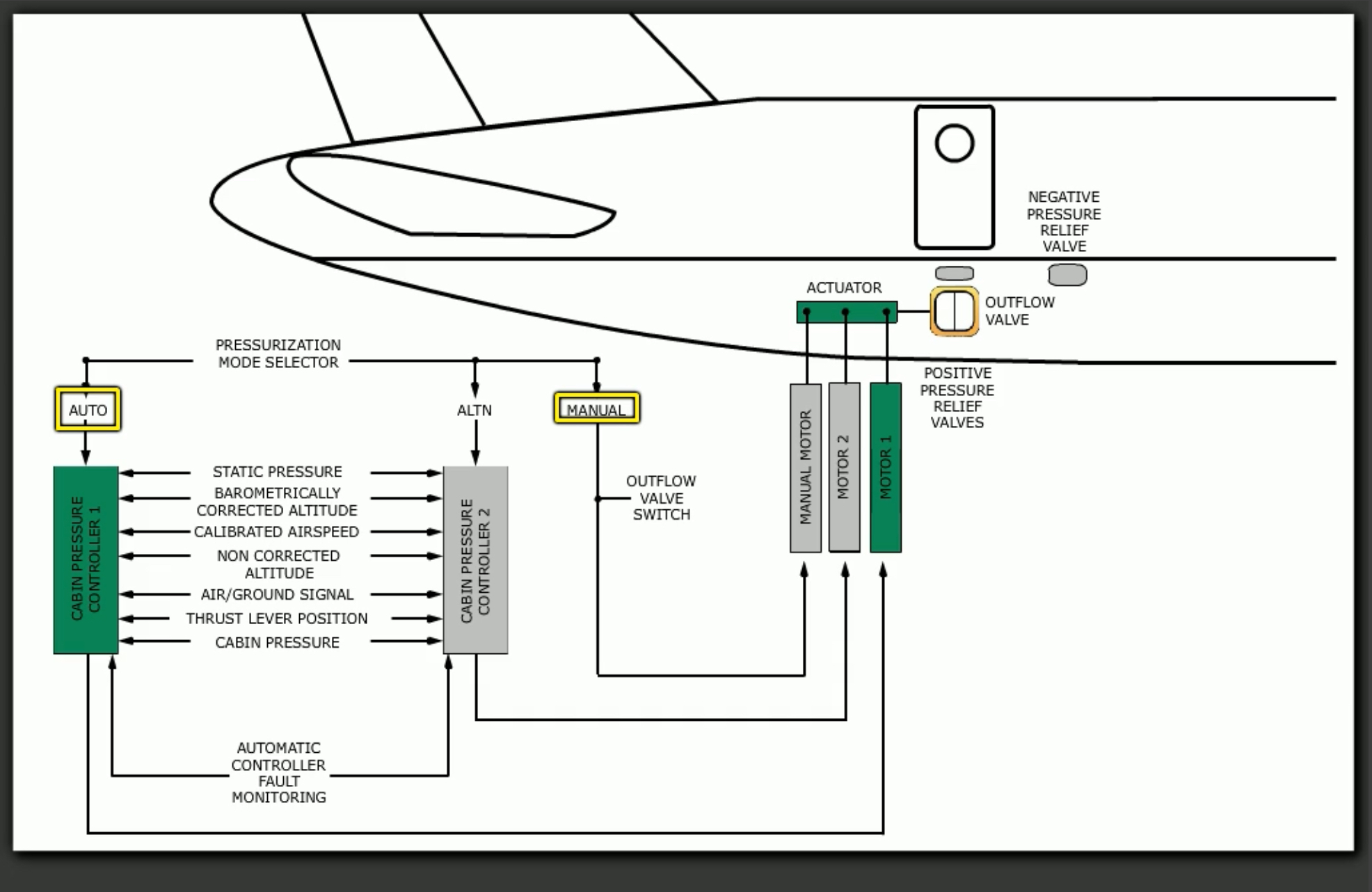
There is a cabin outflow valve that modulates from fully open to fully closed to provide the necessary pressurisation schedule. It operates under two modes:
- Automatic
- Manual
The majority of the passenger cabin air is circulated via foot level grills, around the aft cargo compartment, and then discharged via the outflow valve.
The automatic mode includes two identical controllers located in the E&E compartment. Manual mode is normally only used if auto is MEL’d.
Each of the cabin pressurisation controllers receive data from:
- Static pressure
- Barometrically corrected altitude
- Calibrated airspeed
- Non-corrected altitude
- Air/Ground signal
- Thrust lever position
- Cabin pressure
In addition to automatic controller fault monitoring.
Positive and negative pressure relief valves
There are two positive pressure relief valves. These are fail safe devices that release pressure overboard if the outflow valve fails in the closed position. They will provide pressure relief at 8.95 psi diff and will not allow diff to exceed 9.1 psi.
There is also a single negative pressure relief flapper-type valve. This condition may occur during a rapid descent. The valve is located on the lower aft fuselage on the right side, near the aft service door.
Auto mode
The automatic function of the pressurisation system utilises two identical automatic controllers, Cabin Pressure Controller 1 and Controller 2. The primary controller for each flight alternates between #1 and #2 after each landing.
The pressurisation schedule in AUTO or ALTN mode is determined with data from:
- Air Data System
- Takeoff Field Elevation
- Landing Field Elevation
Each of the cabin pressure controller directly controls a DC powered motor to independently overate the outflow valve. Should the cabin altitude exceed 14,000 ft the DC powered motors automatically close the outflow valve.
The ALTN mode on the Pressurisation Mode Selector the other controller is selected as the main controller, and the green ALTN light illuminates on the overhead. Additionally, should a cabin pressure controller have a fault while in AUTO mode, the following events will occur:
- AUTO FAIL light
- Pressure control transfers to other controller
- Green ALTN light illuminates
The AUTO FAIL light will illuminate for any of the following conditions:
- Controller Fault
- Excessive diff pressure (>8.75 psid)
- Excessive rate of cabin pressure change (>2,000 fpm)
- Loss of DC power
- High cabin altitude (<15,800 ft)
- Outflow valve control fault
The AUTO FAIL light can be extinguished by switching the Pressurisation Mode Selector to ALTN.
Should both controllers fail, the AUTO FAIL light will illuminate, but the ALTN light will be extinguished.
If cabin altitude exceeds 10,000 ft the intermittent cabin altitude warning horn will sound and the red CABIN ALTITUDE warning light illuminates. They may be cancelled with the ALT HORN CUTOUT switch or by decreasing cabin altitude below 10,000 ft.
Controller ground and air modes
During take-off, the cabin altitude descends slightly below take-off airport elevation, and is then controlled to achieve a pressure transition from a ground mode to a flight mode. The maximum diff pressure on take-off is 0.125 psi.
The climb phase of the pressurisation system begins once both of the main landing gear are off the ground. The climb rate of the cabin will be proportional to the aircraft rate of climb.
Note that should a flight be aborted during climb and returns to the takeoff airport, the controller programs the cabin to land at the takeoff airport without further inputs, along with an OFF SCHED DESCENT light. However, should the FLT ALT indicator be changed after take-off, the automatic abort capability is lost.
Cruise mode begins at about 1,000 ft or 0.25 psid away from planned cruise altitude. The cabin diff pressure should be up to 8.35 or 8,000 ft, although the diff may go as high as 8.45 to maintain a constant cabin altitude. Deviations in the amber band of the cabin diff indicator are allowed.
Likewise, descent mode activates once the aircraft descends 0.25 psi below the selected FLT ALT. This will proportionally descent the cabin at a proportional descent schedule to slightly below the selected LAND ALT. This is so that rapid changes in altitude during approach result in minimum cabin pressure changes.
The landing phase of the pressurisation system begins once the aircraft is on the ground and both N1 indications are below a set limit. The max diff pressure for landing is 0.125.
Once the cabin diff pressure is the same as local ambient pressure, the outflow valve will go into the full open position.
Data sources
Each of the pressurisation controllers receive data from:
- Both ADIRUs
- Engine speed data from both of the SMYDs
- Air/Ground logic from the PSEU
- Actual cabin pressure
- Left and right pack valve position
- Overboard exhaust valve position
As well as flight and landing altitude from pilot input via the Cabin Pressurisation panel. This is used to preset the correct pressurisation schedule.
Manual mode
In manual mode the pilots control the position of the pressurisation outflow valve. In manual mode, both cabin pressure controllers are bypassed and the crew directly control a separate DC powered motor. The outflow valve can take up to 20 seconds to travel from full open to full closed when operating the manual switch.
Should the aircraft lose normal AC power, the Manual Mode DC powered motor is powered from the DC standby system.
Prior to entering the landing pattern, slowly position the outflow valve switch to full open to depressurise the aircraft, and verify that diff pressure is zero.
Note that the overboard exaust valve can be driven to the open position in flight by positioning either back switch to HIGH and the right RECIRC FAN switch to OFF. This is known as the Smoke Removal Mode.
When does the primary pressurisation controller in AUTO mode switch?::After each landing. To what altitude do the cabin pressure controllers modulate cabin pressure?::8,000 ft at FL410 or 8.35 psi.
How do the cabin pressurisation controllers manage cabin altitude?::Each controller directly manages a DC powered motor to independently operate the outflow valves. At what altitude will the outflow valve be automatically closed?::Once the cabin altitude exceeds 14,500 ft.
What happens if a fault condition is detected while the pressurisation system is in AUTO?::AUTO FAIL light illuminates, pressure control transfers to other controller, ALTN light illuminates. What causes the pressurisation AUTO FAIL light to illuminate?::Controller fault / >8.75 psi diff / >2,000 ft/min cabin pressure change / loss of DC power / >15,800 ft cabin altitude / outflow valve control fault.
What are the indications of a single auto controller failure?::AUTO FAIL and ALTN lights illuminated.
How do you know if both Cabin Pressure Controllers failed?::AUTO FAIL light is on, ALTN light is extinguished.
When will the cabin altitude horn go off, and how can it be cancelled?::The horn will go off at cabin altitude >10,000 ft, along with the CABIN ALTITUDE light. It can be cancelled with the ALT HORN CUTOUT switch or by decreasing cabin altitude. What does manual pressurisation mode do?::Bypasses both cabin pressure controllers and controls a separate DC powered motor to modulate outflow valve. How many motors are there to control the outflow valve?::3 → Two connected to the cabin pressure controllers, and a manual motor.
How is the manual mode pressurisation motor powered with a loss of AC power?::From the DC standby system. How do you check if the overboard exhaust valve is open?::During external preflight on the ground you should hear and feel the air. How is the forward cargo compartment heated?::Through warm air from the E&E compartment once the aircraft is in flight with an increased differential pressure.
What is the Smoke Removal Mode?::A situation in flight that forces the overboard exhaust open. Set by any pack to HIGH and the right RECIRC FAN to OFF.
What happens if the outflow valve fails closed?::The pressure relief valves should vent the cabin automatically at 8.95 psid.
Where is the negative pressure relief valve located?::On the lower aft fuselage, near the aft service door.
Maximum differential pressure for take-off::0.125 psi.
When does the OFF SCHED DESCENT light illuminate?::When the aircraft descends prior to reaching the planned cruise altitude set in the FLT ALT indicator. When is the automatic pressurisation abort capability lost?::When the FLT ALT indicator is changed prior to reaching planned cruise altitude. What warnings will occur if cabin altitude exceeds 10,000 ft?:: Cabin altitude warning horn sounds and CABIN ALTITUDE warning light illuminates. When does the cruise phase of the pressurisation system start?::When the aircraft is within 0.25 psi of FLT ALT. When does the Overboard Exhaust Valve close?::When the airflow through the valve is more than 30 lbs/min.