Wireless standards are managaged by the IEEE LAN/MAN standards committe, known as the IEEE 802 committee. The wireless networking part of the committe is the 802.11 standard.
“Wi-Fi” is a trademark from the Wi-Fi alliance that is tasked with testing the interoperability of different networks.
These standards are referred to as “wifi standards” to help keep track of the numbering system.
802.11a
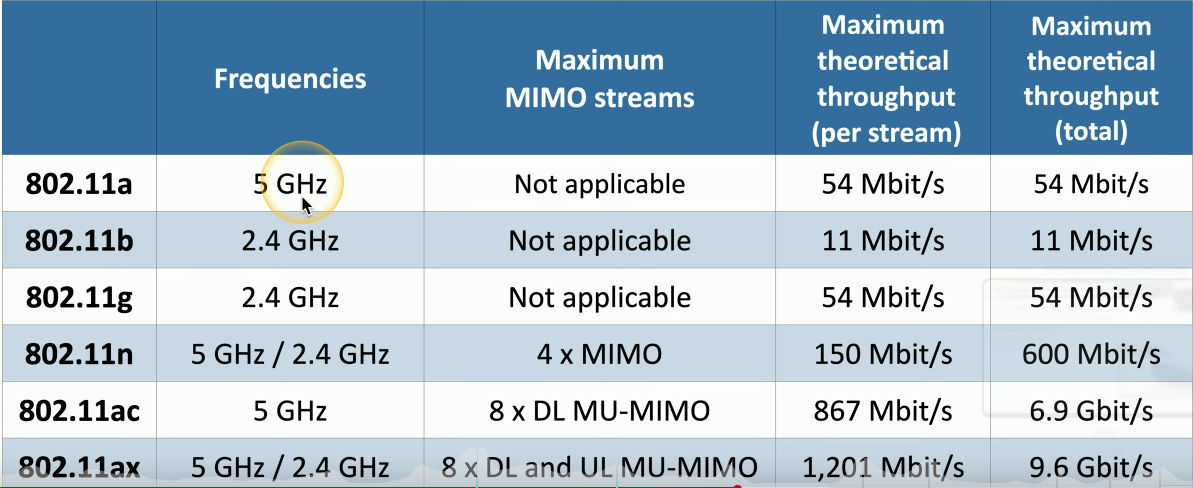
This is one of the first wireless standards, released in 1999. It operates only in 5 Ghz range (or others with special licenses).
It operates at 54 Mbit/s.
It tends to be smaller than the 802.11b spec, since it has a higher frequency assignment and objects tend to absorb the signals.
Not common these days
For example, 802.11a might work better in a warehouse setting because off all the open space.
802.11b
Around the same time 802.11a was finished, 802.11b came out. This is a different standard made for 2.4 GHz frequencies at a maximum speed of 11 Mbit/s.
Its advantage is range, since it has farther reach and bounces of off objects.
For example, 802.11b might work better in an office setting because off all the people and workstations around.
There are also more frequency conflicts, since baby monitors, cordless phones, Bluetooth, and microwave ovens tend to use 2.4 GHz.
Not common today.
802.11g
An upgrade to 802.11b that came out in 2003. Operates in 2.4 GHz, and established the speed to be 54 Mbit/s and is backwards compatible with the 802.11b standard.
802.11n (wifi 4)
In 2009 the 802.11n standard was an update to g,b, and a standards.
Opoerates at 5Ghz and/or 2.4 Ghz simultaneously. There is more bandwith with up to 40 MHz channel widths; the result is that if it can use all the channel widths and 4 antennas it can have a max throughput of 600 Mbit/s.
It uses “MIMO” → multiple input, multiple output. This means we can transfer many types of data at the same time.
802.11ac (wifi 5)
In 2014 there was an improvement with standard that only operates in the 5GHz range. This is an improvement because it is less crowded, and we can use more frequencies (up to 160 Mhz of channel bandwidth.)
Allows for denser signal modulation, which increases data transfer rates.
Adds 8 “Multi User-MIMO” downlink streams, able to manage twice as many streams as 802.11n and can push nearly 7 Gbit/s (867 Mbit/s per channel)
In access points we may see 5GHz/2.4Ghz networks. This is because they may do wifi 5 for 5Ghz and wifi 4 for 2.4 Ghz
802.11ax (wifi 6)
In 2021 we got the successor to 802.11ac.
It operates at both 5Ghz/2.4Ghz with channel widths of 20, 40, 80, and 160 Mhz.
It can push 1202 Mbit/s per channel, meaning almost 10 Gbit/s total, and allows for eight bi-directional MU-MIMO streams.
The main issue that 802.11ax solved was the ability to communicate over networks with a lot of people (say a sporting event, for example). To solve it, Wifi 6 introduced OFDMA (orthogonal frequency-division multiple access), which works similar to cellular communication and improves high-density installations.
Long-range fixed wireless
Home-based AP tend to have a range of about 40 to 50 meters. In an office building setting, we might require longer range (say to connect to building). As a result we use fixed directional antennas set outdoors to have focused point to point connections.
Wireless regulartions may not allow the implementation of long range wifi and additional licensing may be required.
RFID
Radio-frequency identification is a common method to track items, allow access, identify pets, etc.
These tags do not require batteries - they use radar technology, meaning that the signals that go out to read the tag enter the RFID circuit and power the chip itself.
Of course, some RFIDs can be active/powered.
Supports mostly one-way communication
NFC
NFC is an extension of RFID, which allows for two-way communication. UIsed for payment systems or to bootstrap other wireless, and as identity cards.
802.11 technologies
Standard frequencies are 5Ghz and 2.4 Ghz. The channels themselves are groups of frequencies numbered by the IEEE - when installing several APs it is worth while having non-overlapping channels.
Bluetooth uses the 2.4GHz range, which is part of the Unlicensed ISM band (industrial, scientific, medical), allow anyone to set up transmitters in those ranges.
Bluetooth can usually do about 10 meters; industrial bluetooth can increase to 100 meters.