Copper ethernet cable
Wired communications tend to used twister pair copper cabling. These are two wires with equal and opposite signals: Transmit+, Transmit- / Receive +, Receive -.
The twist is necessary to ensure that whatever signal is being sent is continuously twisting away from any interference. Noticeably, each pair of wires has a different twist rate, meaning whatever interference will affect the data at different rates.
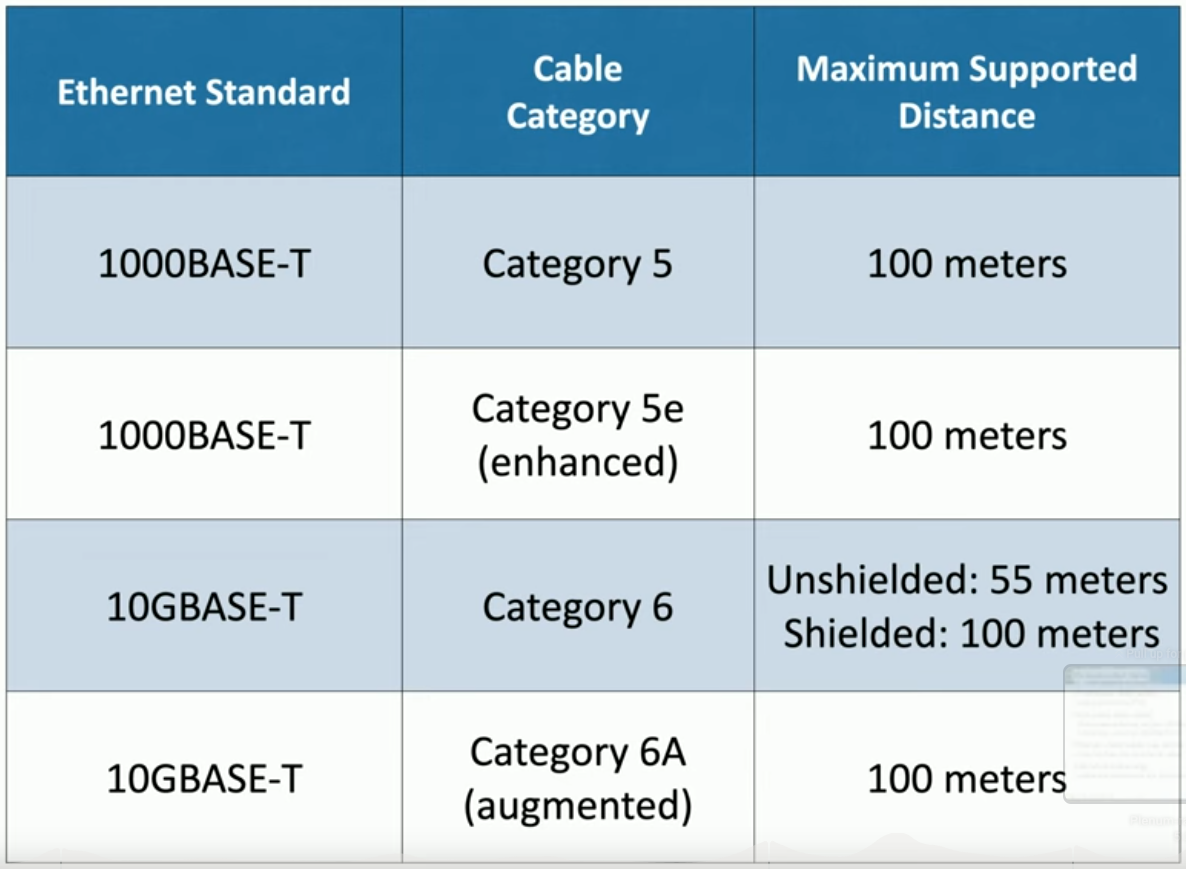
Copper cable categories
Coaxial cable
There are two forms that share a single axis - a wire conductor down the middle with insulator and then metal shielding around it. The most common connector for coax cables is RG-6.
Shielded cables
UTP (Unshielded Twister Pair) cables are the most common type of pair cabling. They don’t have any shielding around them or the individual wires.
STP (Shielded Twisted Pair) cables add addtional protection against interference, but does require the cable to be grounded.
Cable abbreviations
U → Unshielded S → Braided shielding F → Foil shielding
The description is written in the following format:
{overcall cable shielding} / {individual pair shielding} TP
For example, S/FTP cable uses braided shielding around the entire cable and foil shielding around the individual pairs.
Optical wire
There are ethernet standards that support data transmission with light. Their advantage is that they are faster and also more secure, since they don’t have radio frequency signals, making them difficult to monitor or tap.
The signal also runs much longer.
There are two broad categories of fibre connectors:
- Multimode fiber
- multimode is used for short range (up to 2km or so)
- LEDs are usually the light source (inexpensive)
- Called multimode because multiple reflections can occur along the length of the fiber
- Single mode fiber
- Support up to 100km without processing
- Commonly uses lasers
T568A/T568B
These standards refer to what color wires should be punched down into an ethernet connector. They simply specify how the terminations should be placed, and do not allow for crossover at all.
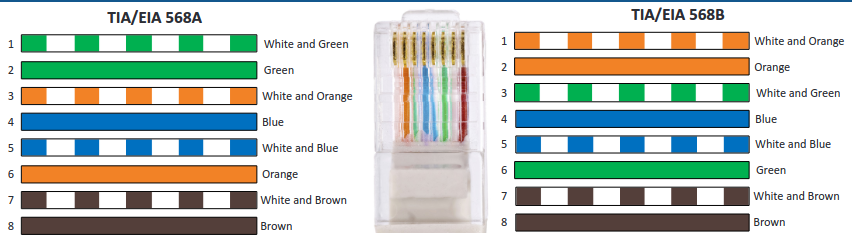
Many organizations use 568B
Installations
Plenum
In forced air-return buildings we might have an area where hot air escapes to, either forced or otherwise. This is generally the area where we will see most cabling installed to avoid toxic fumes.
When placing cables in that area we will use plenum-rated cables. Normal cables have PVC jackets; however, for plenums we must use fire-rated jackets such as FEP (fluorinated ethylene polymer) or low-smoke PVC.
Direct burial STP
Overhead cable is not always a good option, which might require burying cables in the ground. To do so we use shielded braided TP cables that are in sleeves designed to be waterproof, often filled with gel to repel water.